
India's demographic advantage and diverse economic landscape position it uniquely to benefit from AI, the Economic Survey for 2024-25 tabled in the Parliament on Friday afternoon asserted. However, achieving these benefits requires significant investments in education and workforce skilling, supported by enabling, insuring, and stewarding institutions, the state of the economy report tabled by Finance Minister Nirmala Sitharaman said.

Two of the three strikes are related to the gig economy, a centrepiece of the new labour Codes.

The Indian government has launched the Urban Challenge Fund (UCF) with a total outlay of Rs 1 lakh crore, aiming to leverage private and market finance for urban infrastructure projects by providing state support in capacity building and credit guarantees.

It said that the GDP growth has averaged 7.3 per cent from 2014-15 to 2017-18, which is the highest among the major economies of the world.

CAD touched a historic high of $88 billion in 2012-13.
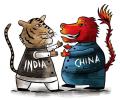
Chinese manufacturing prowess and its dominance in the strategic sector will have a bearing on India's growth projection in the medium term and its march to become a developed nation by 2047, the Economic Survey said on Friday. The Survey has said India needs to grow at 8 per cent for about two decades to become a developed nation by 2047, but it will have to face challenges from global developments and reliance on Chinese imports.

A higher level of private sector financing and resource mobilisation from new sources will be crucial for India to build quality infrastructure, according to the Economic Survey 2023-24. The Economic Survey 2023-24 was tabled in Parliament by Finance Minister Nirmala Sitharaman on Monday.
Inflation is expected to moderate to 6.5-7 per cent by March end but spiralling global crude oil prices pose a challenge in the coming months, said the Economic Survey 2011-12.

India emerged reasonably well from 2025. But now, the oil shock and war-related supply disruptions have again driven funds out of India and significantly weakened the rupee, points out Ajay Chhibber.
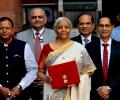
The Budget session of Parliament will be held from January 28 to April 2, featuring the President's address, the Economic Survey, and the presentation of the general Budget.

India's high cost of capital due to relatively shallow corporate bond markets, limited institutional investor depth, sovereign risk premia, and regulatory restrictions on capital flows, is a constraint on private investment and long-run growth, the Economic Survey, authored by Chief Economic Advisor (CEA) V Anantha Nageswaran, said.

India has become the fourth largest economy in the world due to a strong economic growth but still has a low per capita income, the Economic Survey revealed.

During 2013-14, imports from Japan, South Korea and Malaysia stood at $9.49 billion, $12.47 billion and $9.21 billion respectively.

A new poll indicates that President Donald Trump's approval rating is suffering as economic anxieties and the rising cost of living weigh heavily on US voters, revealing deep political divides and widespread dissatisfaction with the government.

Amid a debate over 70-90-hour work week, the pre-Budget Economic Survey on Friday cited studies to state that spending over 60 hours a week on work could have adverse health effects. The survey noted that spending long hours at one's desk is detrimental to mental well-being and individuals who spend 12 or more hours (per day) at a desk have distressed or struggling levels of mental well-being.
India's manufacturing sector growth slowed to a four-year low in March, impacted by cost pressures, competition, market uncertainty, and the Middle East conflict, according to the HSBC India Manufacturing PMI.

India's economy experienced a growth of 7.8 per cent during the October-December quarter of 2025-26, according to the new series of national accounts with 2022-23 as the base year.

'Workers are the people who create all the wealth in this country. How can you call them anti-national?'

Some might contend that a candidate for being termed the most corrupt (or corrupting) country in the world is Switzerland.

From the Sensex firms, Tata Steel tanked the most by 4.57 per cent. ICICI Bank, Power Grid, HCL Tech, Tech Mahindra, Infosys and Kotak Mahindra Bank were also among the laggards. Mahindra & Mahindra, State Bank of India, ITC and Bharat Electronics were among the gainers.

The Reserve Bank's growth projection for next financial year is lower than 8-8.5 per cent projected by the finance ministry in the recent Economic Survey which was tabled in Parliament on January 31. Unveiling the bi-monthly policy, RBI governor Shaktikanta Das said, "Recovery in domestic economic activity is yet to be broad-based, as private consumption and contact-intensive services remain below pre-pandemic levels."

A new survey indicates that Indian employers are planning to increase hiring in the April-June quarter, driven by strong business confidence and domestic demand. The survey also highlights the impact of AI adoption on workforce strategy and the challenges of talent scarcity.
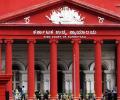
The Karnataka High Court declined to halt the state's socio-economic and educational survey (caste survey) but instructed the government to keep the collected data confidential and ensure participation is voluntary.
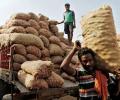
India's economy is projected to grow between 6.3 per cent and 6.8 per cent in FY26, according to the Economic Survey 2024-25, tabled in Parliament on Friday. The survey highlights that the country's economic fundamentals remain strong, supported by a stable external account, fiscal consolidation, and private consumption. It noted that the government plans to strengthen long-term industrial growth by focusing on research and development (R&D), micro, small, and medium enterprises (MSMEs), and capital goods.

The deal shifts the US posture towards India from hostile to neutral, and that matters for growth, points out T T Ram Mohan.
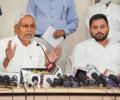
Bihar Chief Minister Nitish Kumar on Wednesday said his government will undertake a "socio-economic survey of all castes and communities" in the state, following the Centre's reluctance to conduct a caste census nationally.

Fitch Ratings on Friday said persistently higher oil prices could cause India's retail inflation to rise faster than the expected gradual pace, and lead to a slowdown in economic growth in the first half of financial year 2026-27 (FY27).

The Survey projected growth rate of 7-7.75 per cent for 2016-17 with downside risks due to weak global economic scenario.

The short-term inflation outlook for India is benign, and the expectation of a normal monsoon and moderating global prices of key imported items give credence to the projections made by the RBI and IMF, the Economic Survey said on Monday. However, to ensure long-term policy stability, the Survey 2023-24 suggested making focused efforts to increase the production of major oilseeds, expanding the area under pulses, and assess the progress in developing modern storage facilities for specific crops.

...is a way out, notes Prem Panicker in his must read blog on the Iran War. What the indefinite extension produces is a prolonged condition of not-war-not-peace, in which oil markets cannot stabilise, Asian refineries cannot plan, European governments cannot stop subsidising consumption they cannot afford, and the next flashpoint -- a seized tanker, a miscalculated drone strike, a Truth Social post that claims too much -- is one news cycle away.

'Secularism or social development or social justice is no longer part of development, according to the youth in Kerala.' 'They are concerned about material wellbeing and material welfare, and they believe that Narendra Modi is capable to giving them that kind of development.' 'So, they don't have any ideological hesitation in voting for him.'

Karnataka Chief Minister announces a ban on social media for children under 16 and increased measures to prevent drug abuse in schools, colleges, and universities, alongside investments in education infrastructure and mental health support.

'When Narendra Modi was here, he spoke only about development and what the BJP wanted to do in Kerala. That kind of sober rhetoric or argument is acceptable to the people here.'

2015 is going to witness new agreements on climate change.

A combination of security pressure and rehabilitation efforts has significantly weakened Naxalism in India, leading to numerous surrenders and the elimination of key leaders.

Karnataka and Andhra Pradesh announce ban social media for teens, sparking debate about its effectiveness, impact on education, and implications for advertisers targeting young audiences.

Sonia Gandhi criticises the government's proposed delimitation, claiming it's a politically motivated move to delay the caste census and gain an unfair advantage, rather than genuinely promoting women's reservation.

'My concern is that, although everything is expressed in monetary terms, you are effectively combining values that have been adjusted using different price measures.'

The Budget reflects a clear focus on strengthening India's long-term prospects by leaning on nation-building sectors such as infrastructure, manufacturing, and technology while maintaining fiscal responsibility.
